Author: rahdigga

  • Switched on Purpose? The Rothschild Claim, Checked Against the Record

    Switched on Purpose? The Rothschild Claim, Checked Against the Record

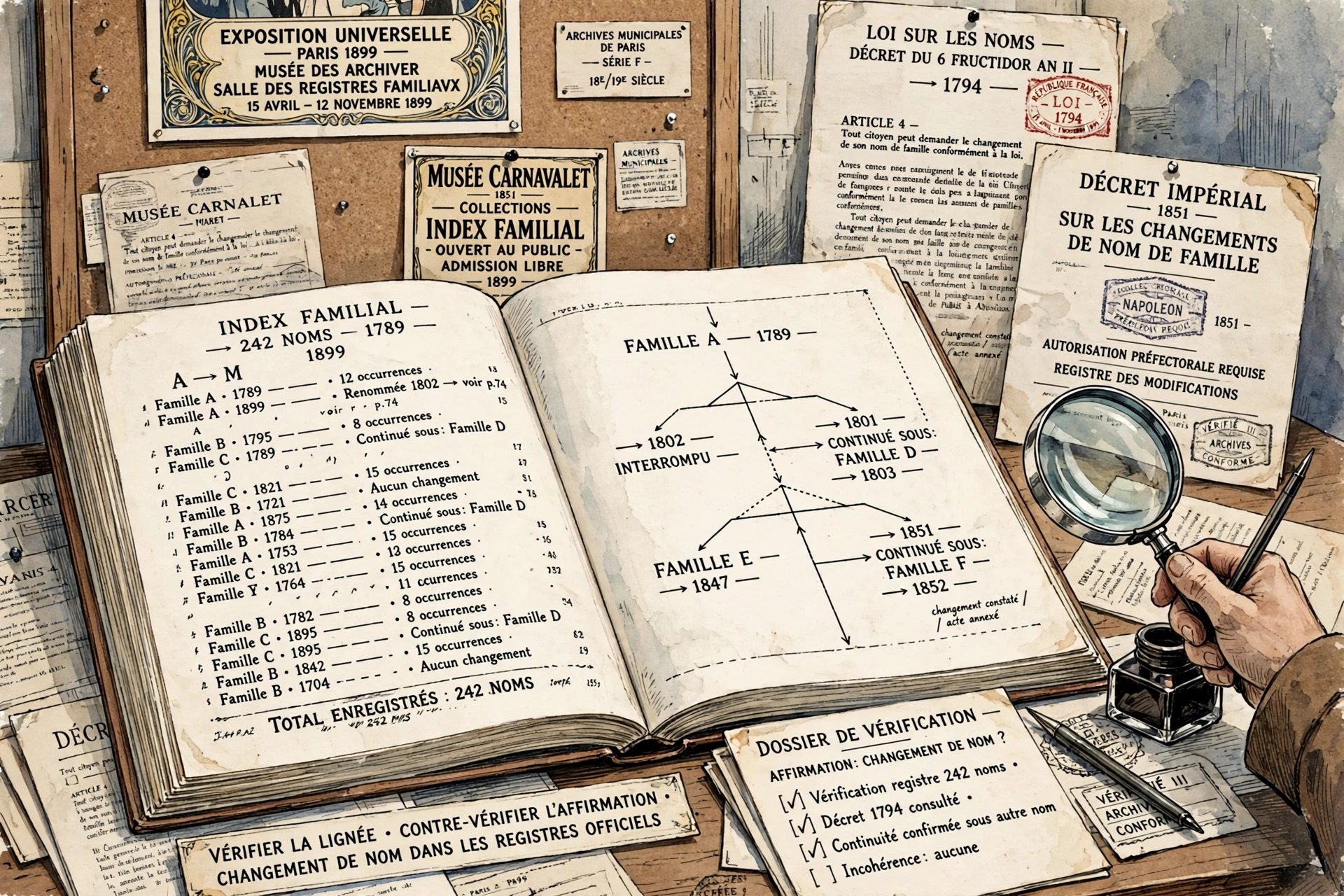
    AI editorial illustration showing an open archive family index, surname law decrees on paper, a family tree whose printed lines stop and continue under other names, and museum poster records.
    AI-generated editorial illustration.

    By Sovereign Chronicles

    The claim, as it circulates

    A popular creator told his audience this month that the Rothschilds are Black — swarthy — and that the switch was intentional: that a dark family stands behind the pale name the world knows. The video — “SWARTHY GERMAN TRILLIONAIRE FUGGER FAMILY HIDING BEHIND PALE SERVANTS,” by Patterns Not Coincidences, posted October 3, 2026 — opened on the Fuggers of Augsburg, but the claim it carries is the one now travelling everywhere: the great German banking house was a swarthy family, and the whitening was done on purpose, by changing the names. The video: https://www.youtube.com/watch?v=plotf_9UNwQ

    What the video says, from its transcript. He argues from the Fugger “book of honours” (the Ehrenbuch), which he says sits in the Library of Congress: that the family arms repeatedly show a crowned, dark-featured woman holding a bishop’s crozier, while the named male portraits wear plain hats — the real Fuggers, in his telling, are dark-skinned Europeans presented to the world through pale stand-ins. Along the way he states, as fact, the documented parts: Fugger copper operations in Bohemia and Hungary and a monopoly over the copper trade (about 1:36–1:50); Fugger financing of Maximilian I and of Charles V’s election as emperor (about 2:28); a “Prince Fugger von Babenhausen,” died 1979, and Babenhausen Castle named as a Fugger property (about 26:51 and 31:26–37:27). The video carries no bibliography and cites no sources.

    A note on this report. The views expressed in the referenced video are the creator’s own, and not every claim in it is accurate — some could not be verified against any record, and this article says so where that is the case. Readers should also know the video and this article discuss period propaganda, including racist caricature, which some audiences will find disturbing. Sovereign Chronicles is verifying specific claims from the video against the documentary record. What follows is that verification — the parts that hold, and the parts that do not.

    This house does not repeat claims. It checks them. So: let’s verify, and let’s look at the record — because parts of this claim touch paper that anyone can pull, and parts of it collapse the moment the paper is pulled. Both halves deserve print.

    What the record shows about how they were depicted

    Start with the characters — the caricatures. In Paris in 1899 and 1900, a series of posters called the Musée des Horreurs rendered the famous Jews of the Dreyfus era as dark, animal hybrids. Baron Alphonse de Rothschild appears — twice — his head on the body of an octopus, catalogued today by the United States Holocaust Memorial Museum. His relatives appear across the series: Karl Mayer, Charlotte, and James — No. 44, “Le baron James,” his face on a crouching dog hoarding sacks of money, in the same Museum’s catalogue. The German scholarship carries the same record: Klaus Herding’s “Die Rothschilds in der Karikatur” (1996) is the standard study of how this family was drawn. The Museum’s own note says the family had no part in the Dreyfus scandal at all; they were targeted for their prominence. The posters are propaganda — that is exactly what makes them evidence. They are the period’s own record of how this family was seen: dark, foreign, other. A description is not a birth record, and this article does not pretend otherwise. But when a claim says a family was depicted as swarthy in its own century, the depictions are the first exhibit, and they exist.

    The quotes travel with the caricatures — and here this article can put a verified one on the record. J. A. Rogers, the Jamaican-American historian who spent four decades collecting the descriptions Europe left of itself, wrote in Nature Knows No Color-Line (1952), citing the anthropologist James Cowles Prichard and the Duchess d’Abrantes, Napoleon’s ambassador’s wife: “So dark were the Jews, especially of Portugal and Southern Spain that many whites thought all Jews were black or dark.” Rogers wrote of the German lands too — of Karl Marx, whose “color so dark he was called ‘The Moor,’” and of the black pages kept in the houses of the nobility, who “usually married into white families” and are found “throughout Europe as far north as Russia.” That is Rogers’ real text, page 123 and pages 130 to 131, and it establishes the ground the claim stands on: in the centuries that made the Rothschilds, darkness in European and Jewish families was described in print, by name, at the level of courts and noble houses — not invented by the internet.

    Other quotes travel with the caricatures that do not survive checking, and this house prints the checking with them. A passage attributed to Virginia Cowles’s The Rothschilds: A Family of Fortune (1973) describes a Bertha, “daughter of Mayer Amschel,” as of “swarthy, Moorish complexion.” The Rothschild Archive’s own index, read in full, lists Mayer Amschel’s daughters — Jeannette, Isabella, Babette, Julie, Henriette. There is no daughter Bertha. A second line, “The Rothschilds, a family of swarthy Jews,” is attributed to an Australian newspaper on the Trove archive; the article itself has not yet been read at source. Both quotes stand in this article labelled what they are — unverified — because a house that checks claims checks its own side first.

    The switch was real — and it was law

    On the name-switching, the record is not rumour; it is statute. Jewish families in the German lands did not drift into new surnames — they were ordered into them. In 1787, Joseph II’s patent required Jews in the Habsburg lands to adopt fixed, German surnames, registered with the state. In 1808, Napoleon’s Bayonne decree imposed the same requirement across his sphere: fixed family names, declared and recorded. Prussia followed in 1812. Mayer Amschel himself was born in Frankfurt’s Judengasse in 1744, under the legal restrictions of the ghetto — the documented root of the house, a generation before the five branches dispersed to Frankfurt, Vienna, London, Naples, and Paris. Whatever else is argued about this family, this much is law on paper: in their world, names were assigned, changed, and registered by governments, and a family’s name in one century is not proof of its name in the next.

    And the seizures stand in the same record. In April 1919, the new Austrian republic passed the Habsburg Law — exiling the Habsburg-Lorraine house and expropriating its property to the state. It is the standing example of what happened to great houses when states moved against them: the property did not evaporate; it was taken, by law, in writing. Houses that survived such centuries survived them the way houses always have — through trusts, entails, marriages, and names that moved.

    Name-switching is not even a hidden practice. In 1917, in the middle of a war, George V renamed his own house by royal proclamation — Saxe-Coburg and Gotha became Windsor, in public, for politics. The Trump family name was Drumpf before it was Trump. This article mentions the Windsors and the Trumps for one reason: so no reader can pretend a famous name is a fixed thing. Names change — by law, by proclamation, by choice. The question is never whether names switch. It is what a particular switch was, and what the record shows underneath it.

    The method, briefly

    Here is how this house tested the claim, in the open. We took the Rothschild Archive’s published family index — 242 named persons — and ran every name against Rashida’s documented family lines across nine houses, under fixed rules declared before the counting: every given-name form, every translation, every interchange in the family’s naming key, run under every surname in play, with matches reported by position — generation and household slot — not by presence alone. That is the whole method. It is the results that matter.

    The results

    Of the 242 persons in the Archive’s index, 155 — 64.0 percent — carry a name that appears in her family’s documented name pool. Ninety-one of the 242 — 37.6 percent — match person for person, name paired with the same name in the same family position: 261 matched pairs in all. Her lines hold 481 names across the nine houses against the Archive’s 242.

    And then there is the shape of the tree itself — her observation, and the finding this claim may actually rest on. Look at the matching lines on the published tree: again and again, the line stops. No descendants printed under them. Her reading, stated as hers: those are the swarthy ones — the branches whose descendants did not disappear but continued elsewhere, under other names, on the far side of the switches the law itself imposed. The desk’s test note stands beside it, in the open: the printed tree is mixed — some matched lines do continue in print — and a full truncation count is runnable from the Archive index whenever she calls for it. The possibility is not proven. It is, on the numbers and the statutes above, a possibility the record does not close.

    The conclusion, in tiers

    What the record shows: a family depicted as dark and foreign by the propaganda of its own era; a legal world in which Jewish names were changed by decree; great houses expropriated by law within living memory of the family’s height; and a name-pool overlap between the Archive’s 242 and one documented family’s lines that is too large to wave away and too loose, yet, to call proof of descent. What the record does not show: the two quotes in verified form, or a document that carries any single Rothschild line into any single Carolina household. What remains standing is the possibility the claim points at, restated the legal way: a family may no longer be found under the name Rothschild — not because it vanished, but because the names were switched, by law and by century, and the lines run on under the names that replaced them.

    Proof. Genealogy. The legal way. That is where this house looks — and the looking continues.


    Sources and further reading: Musée des Horreurs series, United States Holocaust Memorial Museum (Nos. 2, 43, 44, 45, 48); Rogers, Nature Knows No Color-Line (1952), pp. 123, 130–131; Herding, “Die Rothschilds in der Karikatur,” in Jüdische Figuren in Film und Karikatur (1996); Joseph II surname patent, 1787; Decree of Bayonne, 20 July 1808; Prussian emancipation edict, 1812; Habsburg Law (Habsburgergesetz), Austria, 3 April 1919; Royal Proclamation of George V, 17 July 1917; The Rothschild Archive, published family index (242 persons, read in full 2026-10-15); Cowles, The Rothschilds: A Family of Fortune (1973) — quotation UNVERIFIED against the text, placement contradicted by the Archive index, flagged in the article; Trove newspaper article 275914183 — UNVERIFIED, unread at source, flagged in the article; count methodology and clean statement, sources/2026-10-15-rothschild-count-clean-statement.md.

    Updated November 9, 2026.

    Join the movement for Global Recognition of Indigenous Royal Nobility — sign the petition: https://c.org/Ynp8hRLGmf
  • Why Listed as White

    Why Listed as White

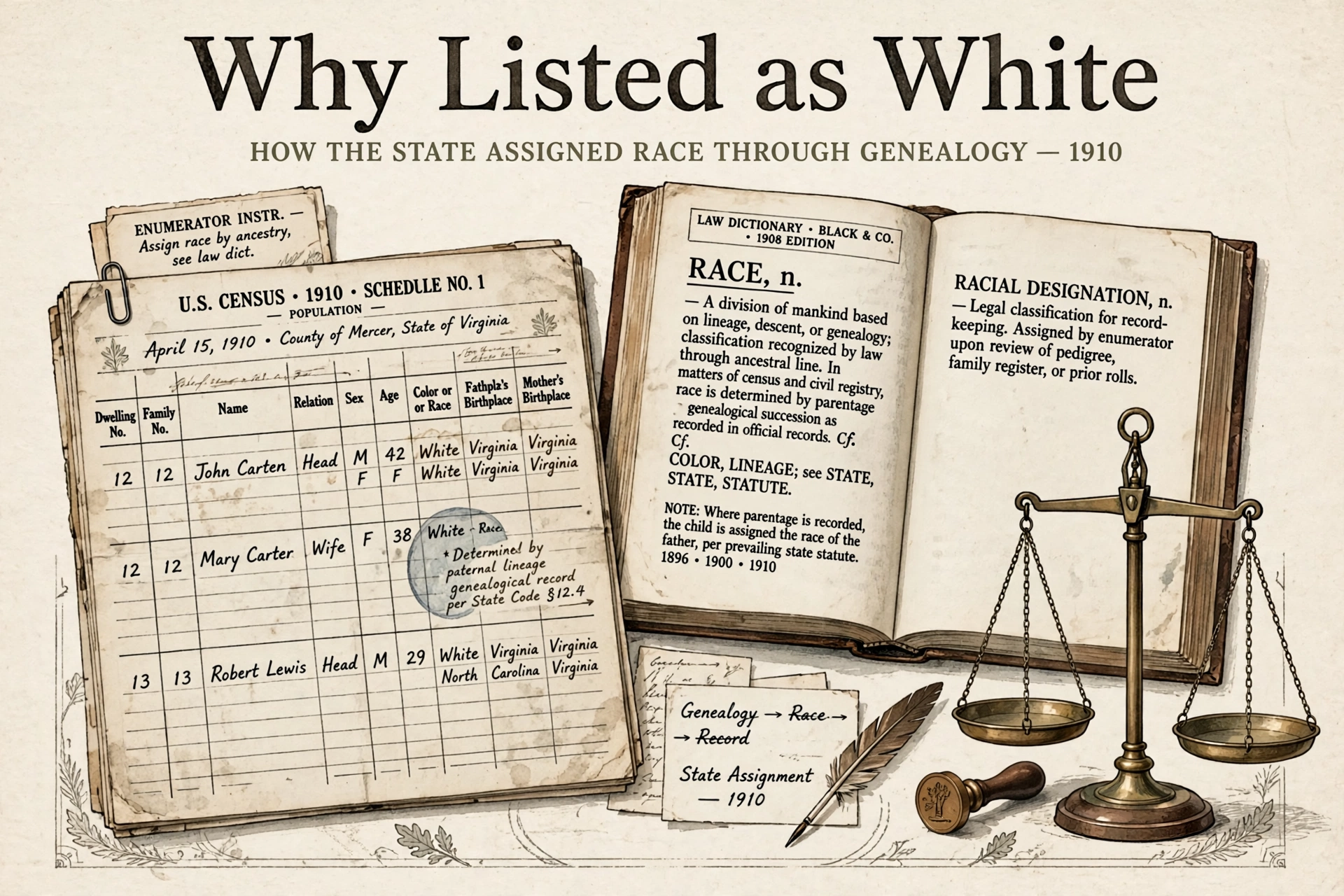
    AI editorial illustration showing a 1910 U.S. Census ledger page with a Color or Race column, an open law dictionary defining race and racial designation, and a brass courthouse scale.
    AI-generated editorial illustration.

    A federal judge, a law dictionary, and a census page explain how the state assigned race—and why genealogy was its proof

    By Sovereign Chronicles

    October 22, 2026

    Open In re Ahmed Hassan at its final pages, where the judge explains the legal method he must follow.

    Ahmed Hassan, a Detroit resident born in Yemen, had skin the opinion calls “undisputedly dark brown.” In 1942 he sought United States citizenship. Because naturalization was restricted by race, the court had to decide whether he was a “white person” under the statute.

    The court did not hold Hassan’s arm beside a color chart. It asked a prior question: to what “particular group or racial subdivision” did he belong? Then it supplied the sentence around which this article turns: “In practical effect, proof of this fact is a matter of genealogy.”

    Hassan lost. The court classified Arabs outside the statutory term and denied his petition. That ending matters: the machinery excluded him. Yet the opinion explains why a government record could call a person white without treating complexion as decisive—and why the proof demanded was descent.

    UP CLOSE: The court’s method

    The passage at pages 845–846 works in three moves.

    First, trace the individual into a group. A skin that differs from the group’s expected color does not by itself move him. Hassan’s plain example is “a dark-skinned Anglo-Saxon,” who “does not thereby acquire a different status” from the rest of his group; the reverse example is a light-skinned Chinese or Japanese person. The group classification controls the individual’s legal status.

    Second, if the mismatch raises a question, genealogy must answer it. The person “bears a strong burden of proof” to show, in the opinion’s words, “by the usual methods of proving genealogy” that he belongs to that group.

    Third, test the group against 1790. Its members are “white persons” only if Congress would have understood them that way when the law was first enacted—not if later ethnologists place them inside a scientific category.

    That doctrine could be hard and unjust, but it is unusually clear: for this legal purpose, race was an assigned group status, established through genealogy and judged by an eighteenth-century term.

    The term was frozen in 1790

    The statute behind Hassan was the Naturalization Act of 1790, 1 Stat. 103, with its phrase “free white persons.” Following Ozawa and Thind, later courts treated that phrase as a popular, historical classification—not a synonym for the scientific category “Caucasian.”

    Black’s Law Dictionary condensed the cases in its entry for “FREE WHITE PERSONS.” Black’s is not the law itself, only a dictionary summarizing what courts had held. Used with that limit, its language is revealing: the entry describes the European races “commonly counted as white” when the phrase was first used, plus their descendants abroad. It expressly includes “the mixed Latin, Celtic-Iberian, and Moorish inhabitants of Spain and Portugal” and Sicily’s mixed peoples, among them its North African inhabitants. It also states that the term “does not mean Caucasian race.”

    Read together, a Moorish line through Spain or Portugal was not outside “free white persons” merely because it was Moorish, and statutory “white” did not mean whatever a later racial scientist put inside a Caucasian boundary. Black’s cannot decide a particular family’s status. It does remove the modern assumption that a Moorish ancestor and a listing as white must contradict each other.

    In 1790, the question was already in South Carolina

    The date is not an abstraction in Rashida’s research. In January 1790, free men at Ninety Six petitioned the South Carolina House, declaring themselves free-born subjects of the Emperor of Morocco who had been unjustly taken and sold. Samuel was among the men; Clarinda’s name stands beside his. The document establishes the men’s stated status. It does not tell us where Clarinda or the other wives were born, and this article does not fill that silence.

    For Rashida, Clarinda begins a family line — and the law of the colonies is the reason the line is traced the way it is. In December 1662, Virginia enacted that all children born in the colony “shall be held bond or free only according to the condition of the mother.” The rule — partus sequitur ventrem, the child follows the mother — displaced the English rule that took a child’s status from the father, and the other Southern colonies, South Carolina among them, took it into their own law. Status descended through the mother. It was written to perpetuate bondage, and it cut the other way for a free woman: her children were born free, and so were theirs.

    Rashida’s documentation follows the course the law itself laid down. Her descent runs from the Clarinda of the 1790 petition down through the mothers to Mary Marshall, and she presents the line as proved on that documentation — traced, as standing was traced in law, mother to child.

    The House answered that men of the petitioners’ status were not to be held under the Negro Act. Weeks later, Congress enacted the federal law containing “free white persons.” The instruments were separate; neither decided the other. Their convergence is narrower: in the same season, lawmakers were sorting free people by status, origin, and category, while names at the root of Rashida’s claimed line stood in a 1790 South Carolina proceeding.

    A census page, a century later

    The 1910 federal census brings the machinery down to one household and one column.

    On May 16, 1910, an enumerator completed Sheet 14 B for Ninety Six Township, Greenwood County, South Carolina. At lines 87–95 he entered George T. Marshall, age 54; his wife, Annie S., age 38; and their children William J., Thomas S., Sybil, John C., James W., Mary B.—age three—and Richard B., age one. In the color or race column, he wrote “W” for every one of them.

    That was not a copying accident or a modern indexer’s invention. On the same sheet, in the same hand, he entered “B” for the surrounding Christopher, Lewis, Matthews, and Fletcher households. Household by household, the state sorted the road. For the Marshall house, it wrote white nine times.

    Within Rashida’s family-claim frame, she places this later Ninety Six household in the Marshall line she is documenting from Clarinda to Mary Marshall. The sheet alone does not prove the precise bridge to her family chart; that link remains a lead. Independently, it establishes that a Marshall household in the family’s township was recorded as white in full while its neighbors were recorded as Black.

    Read beside Hassan—not as though a Michigan opinion governed a South Carolina census—the “W” is more than a guess about shade. It is the state’s group entry. Family oral history supplies Rashida’s flip: paper records the status assigned from outside; memory preserves who the Marshalls were to the people who knew them. Together, the records are fuller than either alone.

    The pen could erase in the other direction

    If a listing could confer the state’s version of a person, it could also replace the person altogether. Matilda McCrear’s death record shows the reverse movement.

    McCrear was born Àbáké in West Africa about 1857. Captured as a small child, she reached Mobile aboard the Clotilda in 1860, survived slavery and sharecropping, and died in Selma on January 13, 1940—the last known survivor of the transatlantic slave trade. Yet her Alabama death record, as cited in genealogical research, says Matilda Crear was born in North Carolina in 1894, to “Osie Craig” and “Gracie Crear,” both also born in North Carolina.

    Africa disappears. The slave ship disappears. More than thirty years of her age disappear. The state supplied another birthplace, another chronology, another family geography.

    That is why “listed as” belongs in the title. A listing is evidence of an official act, not a transparent window into a life. It can preserve a status; it can overwrite an origin until researchers must reconstruct a woman from photographs, family memory, and records of the ship that stole her.

    What the record shows, what the family holds, what remains open

    The record shows a legal method: classify by group, prove the connection by genealogy, and test the group against “free white persons” as understood in 1790. It shows a legal dictionary placing specified Moorish inhabitants of Spain and Portugal within that term, South Carolina refusing to hold the 1790 petitioners under the Negro Act, and a 1910 enumerator writing “W” for a whole Marshall household on a sheet where neighbors are “B.”

    The record also shows the method’s danger. Hassan was denied citizenship under it, and a death clerk moved Matilda McCrear from Africa to North Carolina with a few entries. Classification was power, whether it recognized, restricted, or erased.

    The family holds the identification of the 1910 household with its Marshall line and the oral account of who the Marshalls were in life—hers to present and test. Her line from Clarinda down to Mary Marshall she presents as proved on her documentation, traced through the mothers as the law itself traced status.

    What remains open includes the exact documentary bridge between George T. Marshall’s household and the family chart, and the wives’ unstated origins in the 1790 record. Those gaps are the next places to dig.

    The state classified by group, treated genealogy as proof, and wrote its answer in the column. Rashida’s harder work is to read both the column and the life—and let neither swallow the other.

    Sources and further reading

    • In re Ahmed Hassan, 48 F. Supp. 843 (E.D. Mich. 1942), especially 845–846. Full opinion via Justia.
    • Naturalization Act of 1790, 1 Stat. 103, ch. 3 (“free white persons”).
    • Laws of Virginia, Act XII (December 1662), in Hening, The Statutes at Large — children “held bond or free only according to the condition of the mother” (partus sequitur ventrem), the maternal-status rule adopted across the Southern colonies.
    • Ozawa v. United States, 260 U.S. 178 (1922), and United States v. Bhagat Singh Thind, 261 U.S. 204 (1923), the Supreme Court decisions on which Hassan’s method rests.
    • Henry Campbell Black, Black’s Law Dictionary, 4th ed., entry “FREE WHITE PERSONS” (a secondary reference summarizing the case law).
    • Ex parte Mohriez, 54 F. Supp. 941 (D. Mass. 1944), for the later contrary treatment of an Arab petitioner and the split Hassan did not end.
    • South Carolina House of Representatives, January 1790 free Moors petition and response, Ninety Six; petition account and House answer as preserved in Rashida’s research file.
    • U.S. Census, 1910, South Carolina, Greenwood County, Ninety Six Township, Supervisor’s District 5, Enumeration District 72, Sheet 14 B, lines 87–95 (George T. Marshall household), enumerated May 16, 1910.
    • Hannah Durkin, “Finding Clotilda: Slavery and Memory,” Slavery & Abolition 41, no. 3 (2020), and Sylviane A. Diouf’s 2020 National Geographic research report on Matilda McCrear.
    • Crear/McCrear genealogical paper’s citation to Matilda Crear’s Alabama death record (FamilySearch), for the North Carolina, 1894 entry discussed above.

    Updated November 9, 2026.

    Join the movement for Global Recognition of Indigenous Royal Nobility — sign the petition: https://c.org/Ynp8hRLGmf
  • ‘Fake Royals’ Is a Headline, Not a Status: The Documents Woman & Home Didn’t Cite

    ‘Fake Royals’ Is a Headline, Not a Status: The Documents Woman & Home Didn’t Cite

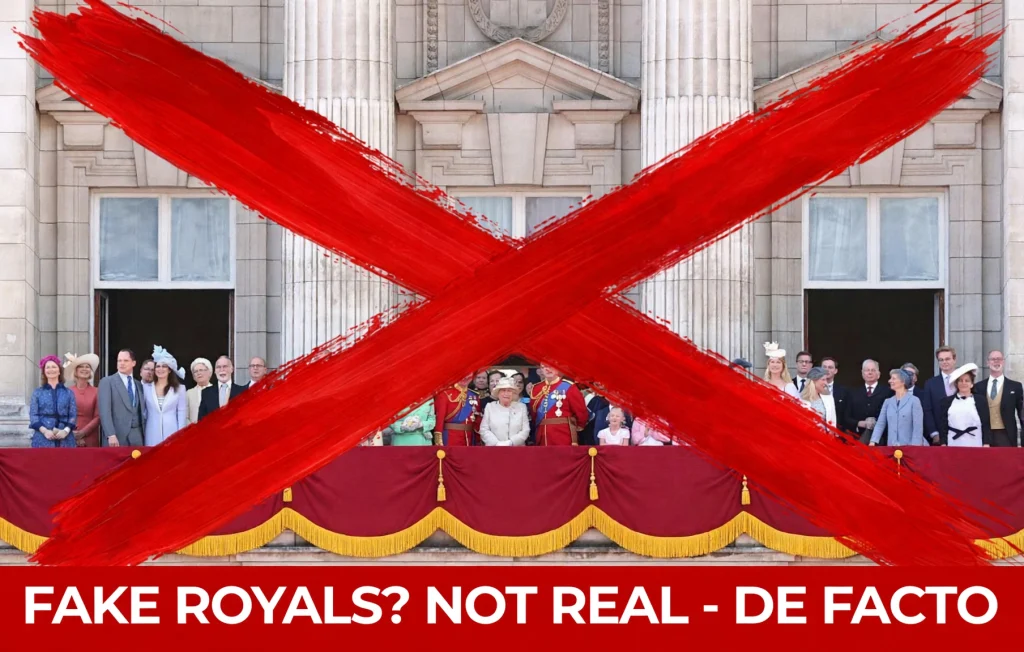
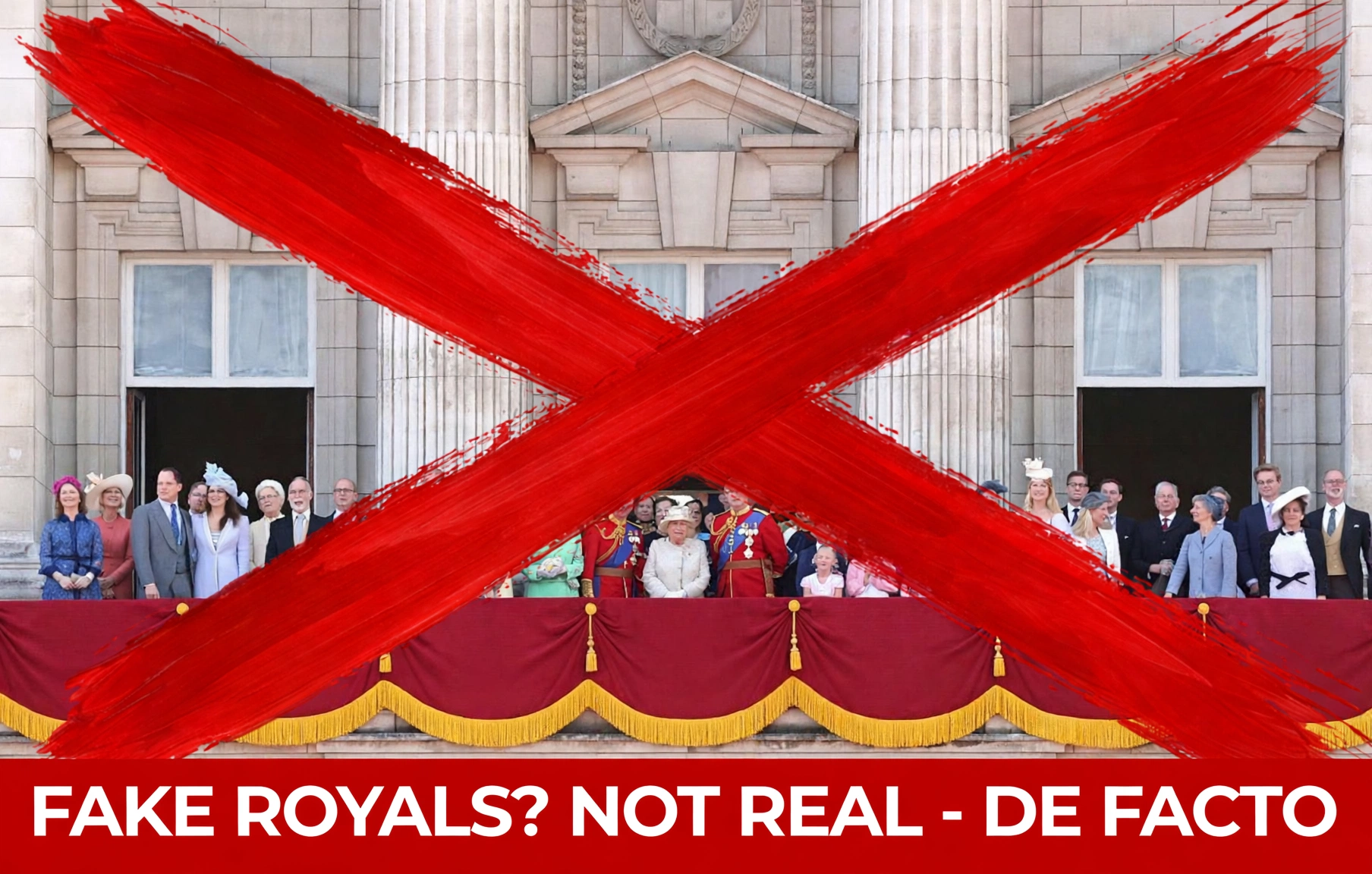
    The Royal Family on the Buckingham Palace balcony, crossed by a red X, banner reading "Fake royals? Not real — de facto." Press photograph with AI-applied graphic overlay.
    Press photograph, graphic overlay applied with AI assistance.

    A magazine has sorted the Royal Family into real and fake. It never mentions that its “real” line holds the throne by an Act of Parliament — or what the record says about the British royals who came before it.

    In Woman & Home, royal editor Emily Andrews offers a definition. “Real royals,” she explains, attend the cold and boring engagements, wear the tiaras and the sashes, say the platitudes about duty, and put the nation before themselves. “Fake royals” — her name for the Duke and Duchess of Sussex — fly to award ceremonies, make television programmes, and spend Christmas in California.

    Read the piece closely and count its evidence. No person is quoted in it. No document is cited in it. Its single statistic — a “95% reduction” in royal work — appears with no source at all. The definition is a preference, printed as a fact. But the deeper problem is not what the article fails to prove about the Sussexes. It is what the article never mentions about the royals it calls real.

    The “real” line holds the throne by statute.

    The succession Andrews treats as ancient and natural was settled by an Act of Parliament. The Act of Settlement 1701 placed the crown, by law, in the line of Sophia, Electress of Hanover — passing over dozens of nearer heirs of the Stuart line — and in 1714 her son travelled from Hanover to London to be crowned George I. The present Royal Family descends from that parliamentary settlement. Its title to the throne is not unbroken ancient tradition; it is a statute, written by politicians, for reasons of state, in living memory of the people it displaced.

    The settlement was not only written. It was enforced. Twice the displaced line’s supporters rose for it — in 1715 and again in 1745 — and twice the Hanoverian hold was kept by arms, ending at Culloden in 1746. The crown the column calls natural was settled by statute, defended by the sword, and held against the senior line by force. And the name it now wears is younger than the motor car. The Royal House was the House of Saxe-Coburg and Gotha until 17 July 1917, when George V, in the middle of a war with Germany, proclaimed it the House of Windsor — a castle’s name, taken for sound — while the Battenbergs became Mountbatten the same week. The thoroughly “British” branding of the “real royals” is a wartime rebrand, just over a century old. It was that same king, in that same year, who issued the Letters Patent of November 1917 defining who is born a prince. He was renaming his own German house with one hand and defining princely birth with the other. The documents record both. The column mentions neither.

    This matters, because the article’s whole test is tradition: who follows the customs, who wears the dress, who shows up. But the customs were rewritten by law the moment law required it — and they have been rewritten since. Under the tradition the column romanticises, the present Princess of Wales, a commoner, could never have married the heir at all: within living memory a king gave up the throne over his marriage, and a princess was refused hers. The “ancient tradition” the fake royals are accused of breaking is a modern edit, staged by the descendants of a German line Parliament installed. One may defend that settlement — many do — but one cannot defend it as timeless while calling anyone else fake.

    And the documents on the Sussexes say what they say.

    Prince Harry is a prince by birth. Under the Letters Patent of George V, 30 November 1917, the children of the Sovereign are Royal Highnesses and Princes by right of birth; the Duke of Sussex is the son of King Charles III. His dukedom was created by letters patent for his marriage on 19 May 2018; his wife took her style from that marriage, as wives do under the practice of the Crown. The Buckingham Palace statement of 18 January 2020 recorded that the couple “will no longer use their HRH styles” — no longer use. Nothing was stripped, nothing revoked; he stands fifth in the line of succession today, and “working royal,” the phrase the entire article leans on, appears in no instrument the Crown has ever issued. It is a staffing category the press invented. It is not a test of blood, and it never has been.

    One more silence in the piece deserves naming.

    The British royals of the older record — the court before the Hanoverian settlement — are the ones the period documents describe in the language this magazine would not print. Charles II, in a character printed in London in 1660: “His Complexion is somewhat dark.” Charlotte, Duchess of Albany, by an eyewitness in Rome in 1786: “very dark complexion.” Elizabeth I, reported by the Venetian ambassador in 1557, “although swarthy”; Anne Boleyn, “swarthy complexion,” by an eyewitness at Calais. These are not internet claims. They are documents, with dates, authors, and shelfmarks, and this House keeps them in a register anyone may check. The imported line that followed carries no such descriptions. A column that divides royals into real and fake might have mentioned which side of that division the written record actually describes. It did not — because the record was never the point.

    That is why this House answers. Legitimacy decided by commentary — by who iced cupcakes in Nottingham and who stood at the Cenotaph, sorted by a columnist into real and fake — is the same machinery by which whole lines were written out of history while the documents sat in the archive saying otherwise. Our order of authority runs the other way: the instrument first, the anecdote second, the headline last. Emily Andrews is entitled to her opinion of the Duke and Duchess of Sussex. She is not entitled to redefine, unsourced and unopposed, what a royal is. Parliament already redefined it once, in 1701, in writing. The Gazette keeps the receipts.

    — By Sovereign Chronicles

    Updated 9 November 2026.

    Join the movement for Global Recognition of Indigenous Royal Nobility — sign the petition: https://c.org/Ynp8hRLGmf