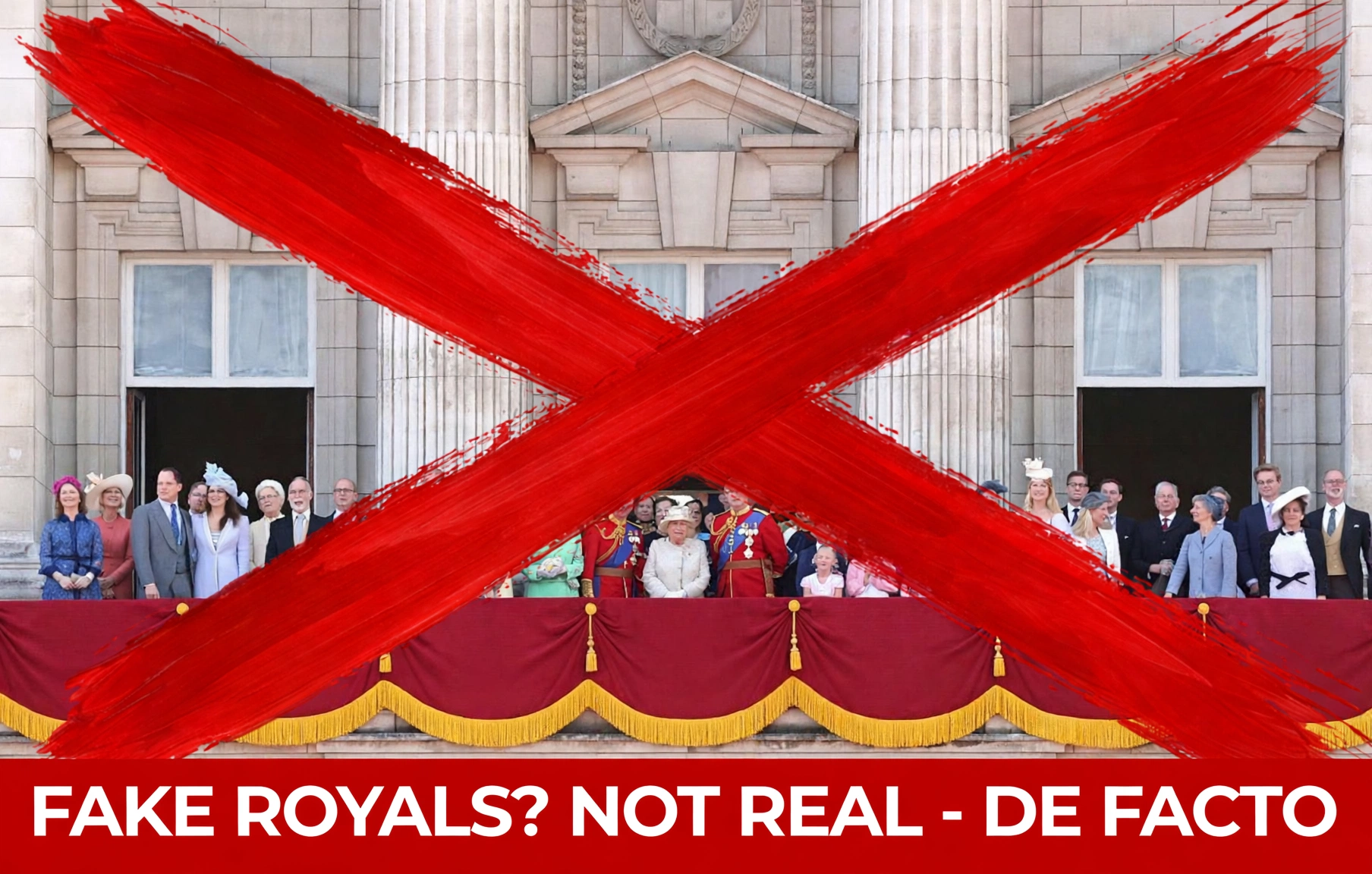
A magazine has sorted the Royal Family into real and fake. It never mentions that its “real” line holds the throne by an Act of Parliament — or what the record says about the British royals who came before it.
In Woman & Home, royal editor Emily Andrews offers a definition. “Real royals,” she explains, attend the cold and boring engagements, wear the tiaras and the sashes, say the platitudes about duty, and put the nation before themselves. “Fake royals” — her name for the Duke and Duchess of Sussex — fly to award ceremonies, make television programmes, and spend Christmas in California.
Read the piece closely and count its evidence. No person is quoted in it. No document is cited in it. Its single statistic — a “95% reduction” in royal work — appears with no source at all. The definition is a preference, printed as a fact. But the deeper problem is not what the article fails to prove about the Sussexes. It is what the article never mentions about the royals it calls real.
The “real” line holds the throne by statute.
The succession Andrews treats as ancient and natural was settled by an Act of Parliament. The Act of Settlement 1701 placed the crown, by law, in the line of Sophia, Electress of Hanover — passing over dozens of nearer heirs of the Stuart line — and in 1714 her son travelled from Hanover to London to be crowned George I. The present Royal Family descends from that parliamentary settlement. Its title to the throne is not unbroken ancient tradition; it is a statute, written by politicians, for reasons of state, in living memory of the people it displaced.
The settlement was not only written. It was enforced. Twice the displaced line’s supporters rose for it — in 1715 and again in 1745 — and twice the Hanoverian hold was kept by arms, ending at Culloden in 1746. The crown the column calls natural was settled by statute, defended by the sword, and held against the senior line by force. And the name it now wears is younger than the motor car. The Royal House was the House of Saxe-Coburg and Gotha until 17 July 1917, when George V, in the middle of a war with Germany, proclaimed it the House of Windsor — a castle’s name, taken for sound — while the Battenbergs became Mountbatten the same week. The thoroughly “British” branding of the “real royals” is a wartime rebrand, just over a century old. It was that same king, in that same year, who issued the Letters Patent of November 1917 defining who is born a prince. He was renaming his own German house with one hand and defining princely birth with the other. The documents record both. The column mentions neither.
This matters, because the article’s whole test is tradition: who follows the customs, who wears the dress, who shows up. But the customs were rewritten by law the moment law required it — and they have been rewritten since. Under the tradition the column romanticises, the present Princess of Wales, a commoner, could never have married the heir at all: within living memory a king gave up the throne over his marriage, and a princess was refused hers. The “ancient tradition” the fake royals are accused of breaking is a modern edit, staged by the descendants of a German line Parliament installed. One may defend that settlement — many do — but one cannot defend it as timeless while calling anyone else fake.
And the documents on the Sussexes say what they say.
Prince Harry is a prince by birth. Under the Letters Patent of George V, 30 November 1917, the children of the Sovereign are Royal Highnesses and Princes by right of birth; the Duke of Sussex is the son of King Charles III. His dukedom was created by letters patent for his marriage on 19 May 2018; his wife took her style from that marriage, as wives do under the practice of the Crown. The Buckingham Palace statement of 18 January 2020 recorded that the couple “will no longer use their HRH styles” — no longer use. Nothing was stripped, nothing revoked; he stands fifth in the line of succession today, and “working royal,” the phrase the entire article leans on, appears in no instrument the Crown has ever issued. It is a staffing category the press invented. It is not a test of blood, and it never has been.
One more silence in the piece deserves naming.
The British royals of the older record — the court before the Hanoverian settlement — are the ones the period documents describe in the language this magazine would not print. Charles II, in a character printed in London in 1660: “His Complexion is somewhat dark.” Charlotte, Duchess of Albany, by an eyewitness in Rome in 1786: “very dark complexion.” Elizabeth I, reported by the Venetian ambassador in 1557, “although swarthy”; Anne Boleyn, “swarthy complexion,” by an eyewitness at Calais. These are not internet claims. They are documents, with dates, authors, and shelfmarks, and this House keeps them in a register anyone may check. The imported line that followed carries no such descriptions. A column that divides royals into real and fake might have mentioned which side of that division the written record actually describes. It did not — because the record was never the point.
That is why this House answers. Legitimacy decided by commentary — by who iced cupcakes in Nottingham and who stood at the Cenotaph, sorted by a columnist into real and fake — is the same machinery by which whole lines were written out of history while the documents sat in the archive saying otherwise. Our order of authority runs the other way: the instrument first, the anecdote second, the headline last. Emily Andrews is entitled to her opinion of the Duke and Duchess of Sussex. She is not entitled to redefine, unsourced and unopposed, what a royal is. Parliament already redefined it once, in 1701, in writing. The Gazette keeps the receipts.
— By Sovereign Chronicles
Updated 9 November 2026.
Join the movement for Global Recognition of Indigenous Royal Nobility — sign the petition: https://c.org/Ynp8hRLGmf
Leave a Reply