
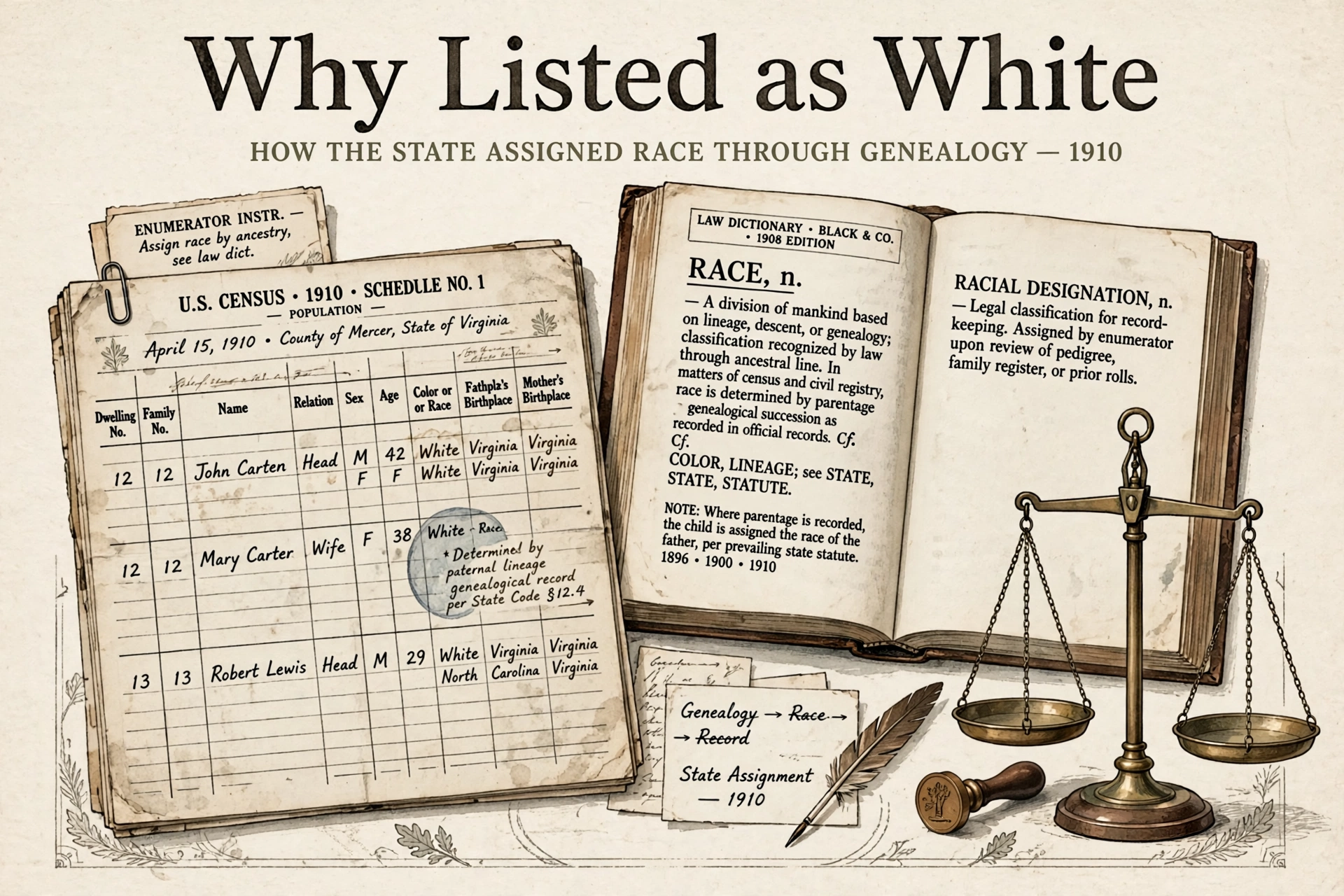
A federal judge, a law dictionary, and a census page explain how the state assigned race—and why genealogy was its proof
By Sovereign Chronicles
October 22, 2026
Open In re Ahmed Hassan at its final pages, where the judge explains the legal method he must follow.
Ahmed Hassan, a Detroit resident born in Yemen, had skin the opinion calls “undisputedly dark brown.” In 1942 he sought United States citizenship. Because naturalization was restricted by race, the court had to decide whether he was a “white person” under the statute.
The court did not hold Hassan’s arm beside a color chart. It asked a prior question: to what “particular group or racial subdivision” did he belong? Then it supplied the sentence around which this article turns: “In practical effect, proof of this fact is a matter of genealogy.”
Hassan lost. The court classified Arabs outside the statutory term and denied his petition. That ending matters: the machinery excluded him. Yet the opinion explains why a government record could call a person white without treating complexion as decisive—and why the proof demanded was descent.
UP CLOSE: The court’s method
The passage at pages 845–846 works in three moves.
First, trace the individual into a group. A skin that differs from the group’s expected color does not by itself move him. Hassan’s plain example is “a dark-skinned Anglo-Saxon,” who “does not thereby acquire a different status” from the rest of his group; the reverse example is a light-skinned Chinese or Japanese person. The group classification controls the individual’s legal status.
Second, if the mismatch raises a question, genealogy must answer it. The person “bears a strong burden of proof” to show, in the opinion’s words, “by the usual methods of proving genealogy” that he belongs to that group.
Third, test the group against 1790. Its members are “white persons” only if Congress would have understood them that way when the law was first enacted—not if later ethnologists place them inside a scientific category.
That doctrine could be hard and unjust, but it is unusually clear: for this legal purpose, race was an assigned group status, established through genealogy and judged by an eighteenth-century term.
The term was frozen in 1790
The statute behind Hassan was the Naturalization Act of 1790, 1 Stat. 103, with its phrase “free white persons.” Following Ozawa and Thind, later courts treated that phrase as a popular, historical classification—not a synonym for the scientific category “Caucasian.”
Black’s Law Dictionary condensed the cases in its entry for “FREE WHITE PERSONS.” Black’s is not the law itself, only a dictionary summarizing what courts had held. Used with that limit, its language is revealing: the entry describes the European races “commonly counted as white” when the phrase was first used, plus their descendants abroad. It expressly includes “the mixed Latin, Celtic-Iberian, and Moorish inhabitants of Spain and Portugal” and Sicily’s mixed peoples, among them its North African inhabitants. It also states that the term “does not mean Caucasian race.”
Read together, a Moorish line through Spain or Portugal was not outside “free white persons” merely because it was Moorish, and statutory “white” did not mean whatever a later racial scientist put inside a Caucasian boundary. Black’s cannot decide a particular family’s status. It does remove the modern assumption that a Moorish ancestor and a listing as white must contradict each other.
In 1790, the question was already in South Carolina
The date is not an abstraction in Rashida’s research. In January 1790, free men at Ninety Six petitioned the South Carolina House, declaring themselves free-born subjects of the Emperor of Morocco who had been unjustly taken and sold. Samuel was among the men; Clarinda’s name stands beside his. The document establishes the men’s stated status. It does not tell us where Clarinda or the other wives were born, and this article does not fill that silence.
For Rashida, Clarinda begins a family line — and the law of the colonies is the reason the line is traced the way it is. In December 1662, Virginia enacted that all children born in the colony “shall be held bond or free only according to the condition of the mother.” The rule — partus sequitur ventrem, the child follows the mother — displaced the English rule that took a child’s status from the father, and the other Southern colonies, South Carolina among them, took it into their own law. Status descended through the mother. It was written to perpetuate bondage, and it cut the other way for a free woman: her children were born free, and so were theirs.
Rashida’s documentation follows the course the law itself laid down. Her descent runs from the Clarinda of the 1790 petition down through the mothers to Mary Marshall, and she presents the line as proved on that documentation — traced, as standing was traced in law, mother to child.
The House answered that men of the petitioners’ status were not to be held under the Negro Act. Weeks later, Congress enacted the federal law containing “free white persons.” The instruments were separate; neither decided the other. Their convergence is narrower: in the same season, lawmakers were sorting free people by status, origin, and category, while names at the root of Rashida’s claimed line stood in a 1790 South Carolina proceeding.
A census page, a century later
The 1910 federal census brings the machinery down to one household and one column.
On May 16, 1910, an enumerator completed Sheet 14 B for Ninety Six Township, Greenwood County, South Carolina. At lines 87–95 he entered George T. Marshall, age 54; his wife, Annie S., age 38; and their children William J., Thomas S., Sybil, John C., James W., Mary B.—age three—and Richard B., age one. In the color or race column, he wrote “W” for every one of them.
That was not a copying accident or a modern indexer’s invention. On the same sheet, in the same hand, he entered “B” for the surrounding Christopher, Lewis, Matthews, and Fletcher households. Household by household, the state sorted the road. For the Marshall house, it wrote white nine times.
Within Rashida’s family-claim frame, she places this later Ninety Six household in the Marshall line she is documenting from Clarinda to Mary Marshall. The sheet alone does not prove the precise bridge to her family chart; that link remains a lead. Independently, it establishes that a Marshall household in the family’s township was recorded as white in full while its neighbors were recorded as Black.
Read beside Hassan—not as though a Michigan opinion governed a South Carolina census—the “W” is more than a guess about shade. It is the state’s group entry. Family oral history supplies Rashida’s flip: paper records the status assigned from outside; memory preserves who the Marshalls were to the people who knew them. Together, the records are fuller than either alone.
The pen could erase in the other direction
If a listing could confer the state’s version of a person, it could also replace the person altogether. Matilda McCrear’s death record shows the reverse movement.
McCrear was born Àbáké in West Africa about 1857. Captured as a small child, she reached Mobile aboard the Clotilda in 1860, survived slavery and sharecropping, and died in Selma on January 13, 1940—the last known survivor of the transatlantic slave trade. Yet her Alabama death record, as cited in genealogical research, says Matilda Crear was born in North Carolina in 1894, to “Osie Craig” and “Gracie Crear,” both also born in North Carolina.
Africa disappears. The slave ship disappears. More than thirty years of her age disappear. The state supplied another birthplace, another chronology, another family geography.
That is why “listed as” belongs in the title. A listing is evidence of an official act, not a transparent window into a life. It can preserve a status; it can overwrite an origin until researchers must reconstruct a woman from photographs, family memory, and records of the ship that stole her.
What the record shows, what the family holds, what remains open
The record shows a legal method: classify by group, prove the connection by genealogy, and test the group against “free white persons” as understood in 1790. It shows a legal dictionary placing specified Moorish inhabitants of Spain and Portugal within that term, South Carolina refusing to hold the 1790 petitioners under the Negro Act, and a 1910 enumerator writing “W” for a whole Marshall household on a sheet where neighbors are “B.”
The record also shows the method’s danger. Hassan was denied citizenship under it, and a death clerk moved Matilda McCrear from Africa to North Carolina with a few entries. Classification was power, whether it recognized, restricted, or erased.
The family holds the identification of the 1910 household with its Marshall line and the oral account of who the Marshalls were in life—hers to present and test. Her line from Clarinda down to Mary Marshall she presents as proved on her documentation, traced through the mothers as the law itself traced status.
What remains open includes the exact documentary bridge between George T. Marshall’s household and the family chart, and the wives’ unstated origins in the 1790 record. Those gaps are the next places to dig.
The state classified by group, treated genealogy as proof, and wrote its answer in the column. Rashida’s harder work is to read both the column and the life—and let neither swallow the other.
Sources and further reading
- In re Ahmed Hassan, 48 F. Supp. 843 (E.D. Mich. 1942), especially 845–846. Full opinion via Justia.
- Naturalization Act of 1790, 1 Stat. 103, ch. 3 (“free white persons”).
- Laws of Virginia, Act XII (December 1662), in Hening, The Statutes at Large — children “held bond or free only according to the condition of the mother” (partus sequitur ventrem), the maternal-status rule adopted across the Southern colonies.
- Ozawa v. United States, 260 U.S. 178 (1922), and United States v. Bhagat Singh Thind, 261 U.S. 204 (1923), the Supreme Court decisions on which Hassan’s method rests.
- Henry Campbell Black, Black’s Law Dictionary, 4th ed., entry “FREE WHITE PERSONS” (a secondary reference summarizing the case law).
- Ex parte Mohriez, 54 F. Supp. 941 (D. Mass. 1944), for the later contrary treatment of an Arab petitioner and the split Hassan did not end.
- South Carolina House of Representatives, January 1790 free Moors petition and response, Ninety Six; petition account and House answer as preserved in Rashida’s research file.
- U.S. Census, 1910, South Carolina, Greenwood County, Ninety Six Township, Supervisor’s District 5, Enumeration District 72, Sheet 14 B, lines 87–95 (George T. Marshall household), enumerated May 16, 1910.
- Hannah Durkin, “Finding Clotilda: Slavery and Memory,” Slavery & Abolition 41, no. 3 (2020), and Sylviane A. Diouf’s 2020 National Geographic research report on Matilda McCrear.
- Crear/McCrear genealogical paper’s citation to Matilda Crear’s Alabama death record (FamilySearch), for the North Carolina, 1894 entry discussed above.
Updated November 9, 2026.
Join the movement for Global Recognition of Indigenous Royal Nobility — sign the petition: https://c.org/Ynp8hRLGmf
Leave a Reply