Plato named ten kings, one bloodline, and an island that vanished. This is their story.
Sovereign Chronicles: The True Royal Bloodline of An and Ki — Episode 1
By Sovereign Chronicles
November 9, 2026
Series lens: This series traces royal bloodlines from the sky to the earth, working from primary texts alongside the archaeological record, with the Holy Tablets of Dr. Malachi Z. York as the interpretive lens. What the documents say and what the lens says are kept distinct throughout.
Sail west past the Pillars of Hercules — past the rock the old world called the edge of everything — and the maps go blank.
But one map does not. It was drawn in words, four hundred years before Christ, by a philosopher in Athens who said he was only repeating what he had been told. Beyond the blank water, he said, there was an island larger than Libya and Asia put together. And it was ruled by ten kings — all of them brothers, all of them sons of a god, all of them answering to a single bloodline.
This is Plato’s account. Whether you read it as history, as allegory, or as something in between, notice what it is really describing: not a city, but a dynasty. A royal seed, transmitted from the sky to the earth, and guarded by law for generations — until the blood thinned.
And notice how Plato says he got it. The story comes down a chain: Egyptian priests at Sais told it to Solon, the lawgiver of Athens, when he visited Egypt; Solon told it to his friend Dropides; Dropides told his son Critias; Critias told his grandson, the Critias who speaks in the dialogue. Picture it: an old priest at Sais unrolling temple records before a visiting Greek, telling him that Athens itself is older than Athens knows — that nine thousand years before, an Athenian army turned back an empire from the western sea. Whether the chain is history or stagecraft, Plato built his account on the oldest trick in the historian’s book: the document that was always there, in a temple you cannot enter.
It begins the way these stories always begin: with the gods dividing the world. When the old deities cast lots for the earth, Poseidon — god of the sea — drew an island in the Atlantic, and it pleased him. On the island’s central hill lived a mortal family: Evenor, earth-born, and his wife Leucippe, and their daughter Cleito. When Cleito’s parents died, Poseidon fell in love with her. And being a god, he did not simply take a wife. He rebuilt the island around her.
He broke the ground in a circle and raised alternating rings — two of land, three of water — turned as if on a lathe, each ring the same distance from the center all the way around, so that no ship of that age could ever reach the middle. From beneath the earth he drew two springs, one warm and one cold. From the soil he made every kind of food grow in abundance. Then, with Cleito, he raised five pairs of twin sons — ten princes, born of a god and a mortal woman.
And here is the bloodline, exactly as Plato names it. Poseidon divided the island into ten portions. The firstborn of the eldest pair received his mother’s dwelling and the largest, richest land — and was made king over the rest. The others became princes, each with his own territory and his own people.
The eldest he named Atlas — and after Atlas, Plato says, the whole island and the entire ocean were called Atlantic. Atlas’s twin, who drew the far western edge toward the Pillars, was called Eumelus in Greek, Gadeirus in the island’s own tongue — a name that survives to this day in the region of Gades. Then Ampheres and Evaemon. Mneseus and Autochthon. Elasippus and Mestor. Azaes and Diaprepes.
Ten names. Ten thrones. One father.
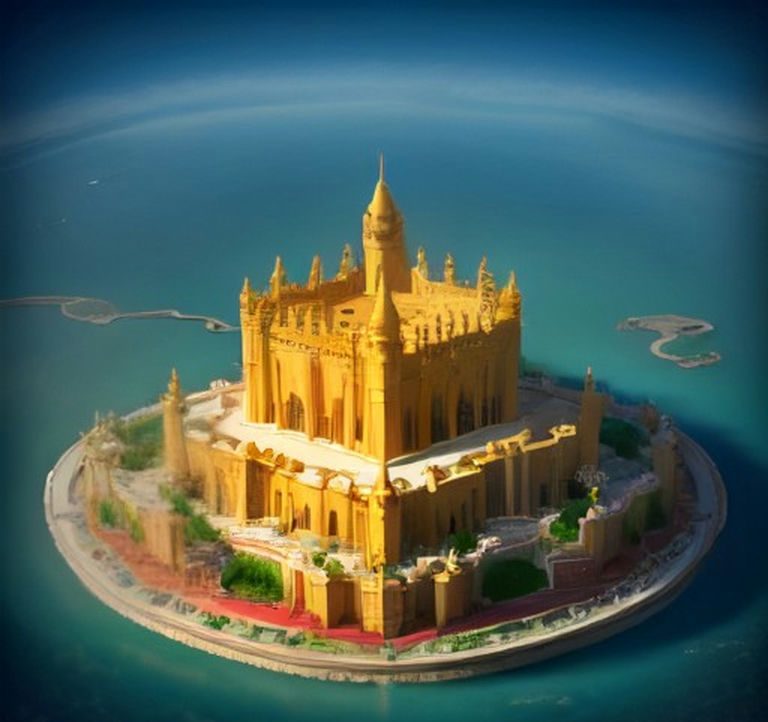
Plato engineers the island the way an architect draws a fortress. The great plain — three thousand stadia by two thousand, he says — is ringed by mountains and cut by straight canals. At its center the rings: harbors bridged and roofed, a palace at the middle flashing with orichalcum, the strange red-gold metal second only to gold. The outer wall of the city, Plato writes, was coated with brass; the next with tin; the innermost gleamed with orichalcum. Warships filled the harbors. Elephants — yes, elephants — roamed the island. It is the most precisely described place in ancient literature that no one can find on a map.
Their descendants, Plato says, ruled for many generations — not only the island, but islands across the open sea, and lands within the Pillars as far as Egypt and Tyrrhenia. And they governed themselves by law. Every five years the kings gathered at the center of the island, where their ancestral laws were inscribed on a column — a sacred constitution. They swore they would never war against one another, that they would come to each other’s aid, that plans of war would be made in common. And one clause stood above all the rest: supreme authority belonged forever to the descendants of Atlas. The firstborn’s line would always lead.
The ritual that sealed it is the strangest and most vivid scene Plato ever wrote. The kings hunted a bull on the temple grounds — with staves and nooses only, no iron weapons — and led it to the column. There they cut its throat over the inscribed laws, so the blood ran down the writing, and swore the oath: to judge by the laws, to war against no brother-king, to come to one another’s aid. Then they drank, and sat in judgment over each other until dawn, writing their sentences on tablets of gold. Law, blood, and gold — the whole constitution performed in a single night, every five years, for generations.
For generations, it worked. Plato says the kings were noble because the divine nature in them was still strong. But blood thins. With every generation the god’s portion faded, mixed with mortal stock, until the human temper took over — and the kings who had once ruled by law became filled, in Plato’s words, with unrighteous avarice and power. Zeus looked down, saw a noble race in a wretched state, and resolved to chastise them, to set them back in order.
And then — the sentence stops. Mid-thought. The dialogue breaks off, and the punishment is never described. The oldest royal bloodline in Western literature ends in a silence.
Scholars have spent two thousand years trying to fill it. The most famous proposal ties Atlantis to Thera — the Aegean island blown apart by a volcanic eruption around 1600 BCE, which buried the Minoan town of Akrotiri in ash. The dates do not fit Plato’s nine thousand years, the geography does not fit the Atlantic, and the ten kings have no Minoan counterpart — but the hunger to anchor the story is itself a kind of evidence. People do not spend millennia hunting for a place they believe was never there.
Now open the lens of this series. The Holy Tablets name a water-lord of their own: Enqi, firstborn of ANU, master scientist whose home is water, who comes down to the joining of the rivers and founds Eridu — the first city. Set him beside Poseidon, sea god, engineer of a ringed island-city, father of ten kings. The names change. The seat is the same: the divine lord of waters who founds the first kingdom and fathers its royal line. And the Tablets place Atlantis itself in western waters — the Bermuda Triangle, where they say the old ones refused to surrender.
And the Tablets’ water-lord has a brother — because the oldest frame of all is a family. In the Sumerian record, the sky god Anu has two great sons, and the world is divided between them. Enlil takes the air: wind and storm, command and decree, the god whose word is law. Enki takes the waters: the Abzu, the deep beneath the earth — and with it wisdom, craft, and cunning, and the first city, Eridu, where the King List says kingship first came down.
Hold the brothers apart, because the flood turns on the difference. In the Eridu Genesis, it is Enlil — the Air — who is offended by mankind’s noise and resolves upon the flood, and the gods are sworn to silence. And it is Enki — the Sea — who breaks the oath, warning Ziusudra to build the boat. The seed of mankind survives the judgment of the air by the mercy of the waters. Enki’s own emissaries carry the same signature: the apkallu, the seven sages of the deep, the first of them remembered by the Babylonian priest Berossus under the Greek name Oannes — a figure who rose from the Gulf waters each day to teach men letters, law, land-measure, and the founding of cities, counselor to the kings before the flood. Civilization itself, in Babylon’s telling, came up out of the sea.
Now set Plato on that frame. Atlantis is a sea god’s kingdom: Poseidon fathers its kings, as Enki fathers the arts and preserves the line. And the judgment that hangs over it is decreed from the sky side — Zeus, like Enlil, resolving to set a corrupted greatness back in order. The Air judges. The Sea preserves. That is the comparative reading this series works by, and it is offered as exactly that — but the brothers themselves, their elements, and their quarrel over mankind’s survival are not our invention. They are on the tablets.
That is the lens speaking, and it is marked as such. What the stones establish is simpler: in the fourth century before Christ, a text described a confederation of ten kings, bound by written law, tracing every throne to one divine father — and warned that when the blood thinned, the kingdom fell.
But Plato’s is not the only old record of that world. Open the other library — the Bible — and the very first city it ever names belongs to an exile. Cain, marked and driven out, goes east of Eden into the land of Nod, and there he builds a city and names it after his son: Enoch. The first city in Scripture is a Cain-line city, raised in a land the text treats as already peopled — Cain had feared, in his own words, that whoever found him would kill him. Who was already out there, east of Eden, to fill an exile’s city? Genesis does not answer. It simply builds.
And Genesis holds two Enochs, not one. Down the other line — the line of Seth — comes Enoch son of Jared, the man who walked with God and was taken, who did not see death. It is to him that tradition attaches the Book of Enoch, and that book is Plato’s silhouette drawn from the other side. In the days of Jared, it says, two hundred Watchers descended on Mount Hermon. They took wives. Their children were giants. And the fallen ones taught: Azazel taught men to make swords and knives and shields, and the art of working metals. Heaven-sent knowledge, a hybrid generation, a world grown enormous and violent — and then, in both accounts, the judgment of the waters. A divine seed. Gifted arts. A bloodline that corrupts. A flood. Different libraries, one silhouette.
The silhouette is not only in books, either. Cross the Atlantic and the Americas kept their own memory of the made-by-gods city world. On the high plain by Lake Titicaca stands Tiahuanaco, the sacred city the Andean world binds to the creator’s own making. In the valley of Mexico rose Teotihuacan — in the tongue of those who named it, the place where the gods were made — a gridded city of pyramids already ancient and abandoned when the Aztecs found it and wondered who could have built it. And a reader of this series has flagged the echo sitting inside the Aztec capital’s own name: Tenochtitlan — TEnoch. That is wordplay, and it is filed here as wordplay, not etymology. But the question underneath it is a real one: why do both shores of the ocean remember a first age of cities built under heaven’s direction?
So the thread of this series, stated plainly and marked as a thread: Cain’s Enoch in Nod, the Watchers on Hermon, and Plato’s ten kings of the sea read like three tellings of one pre-flood order — an earth-spanning network of cities, builders, and sea kings, whose surviving branches went on calling themselves royal long after the waters took the center of it. What is documented is plainer, and strange enough on its own: the oldest texts we have, from both sides of the Atlantic world, keep describing the same kind of beginning.
Kingship descended from heaven. That is what the Sumerians wrote. Plato wrote the other half of the sentence: and heaven takes it back.
Next in the series, we follow the bloodline east — to the kings and queens of Sumer, where the lion first wore a crown, and the royal seed touched the earth it would never leave.
Sources: Plato, Critias (public domain; the ten-king genealogy, the ring-city, the column of laws, the thinning of the blood, the unfinished ending) · The transmission chain (Egyptian priests at Sais → Solon → Critias) is Plato’s claim, not independently established · The Thera/Minoan hypothesis and its problems (chronology, Feder’s radiocarbon critique) · The series’ interpretive lens: The Holy Tablets by Dr. Malachi Z. York (Enqi as water-lord; Atlantis/Bermuda Triangle mentions — royal-bloodline extraction filed with this series’ source materials) · Added 2026-10-13 (Enoch/Nod update, brought over from the main research sessions): Genesis 4:16–17 (Cain in Nod; the city named Enoch) and Genesis 5:18–24 (Enoch son of Jared) — public-domain text · The Book of Enoch (1 Enoch 6–8), trans. R. H. Charles (public domain): two hundred Watchers, Mount Hermon, the giants, Azazel’s teaching of metalwork and weapons · Tiahuanaco (Tiwanaku) as the Andean sacred city of the creator traditions · Teotihuacan — “the place where the gods were made” is the conventional gloss of its Nahuatl name; the city was already ancient and abandoned when the Aztecs named it · The Tenochtitlan/“TEnoch” reading is a reader-flagged wordplay, not established etymology · The Cain-Enoch → Atlantis connection is stated in the text as this series’ interpretive thread · Two Brothers bridge (added 2026-10-13): the Sumerian King List (Eridu as the first seat of kingship) · The Eridu Genesis (Enlil resolves on the flood; Enki warns Ziusudra) · The Atrahasis and Gilgamesh flood traditions (Enlil sends; Ea/Enki warns and preserves) · Berossus, Babyloniaca fragments (Oannes and the apkallu, sages of the Apsu, teachers of letters, law, and city-founding) · The Enki-Poseidon / Enlil-Zeus alignment is the series’ comparative reading, marked as such in the text.
Updated November 9, 2026.
Join the movement for Global Recognition of Indigenous Royal Nobility — sign the petition here: https://c.org/Ynp8hRLGmf
Leave a Reply