
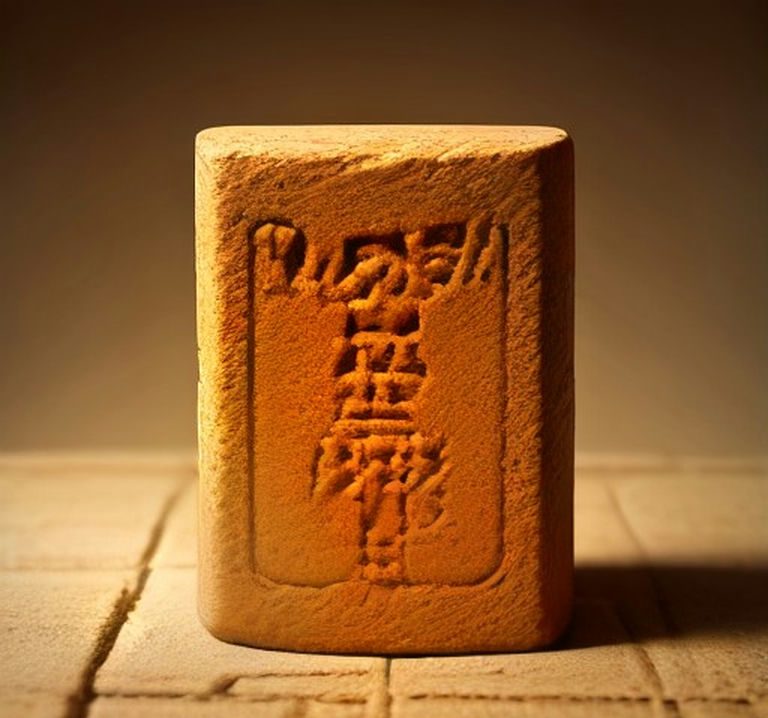
Eight kings. 241,200 years. The most audacious chronological claim ever pressed into clay.
Sovereign Chronicles: The True Royal Bloodline of An and Ki — Sumer, Article 1: the overview
By Sovereign Chronicles
November 9, 2026
Series lens: This series traces royal bloodlines from the sky to the earth, working from primary texts alongside the archaeological record, with the Holy Tablets of Dr. Malachi Z. York as the interpretive lens. What the documents say and what the lens says are kept distinct throughout.
There is a clay prism in the Ashmolean Museum in Oxford. It is small — about twenty centimeters tall, nine across — baked hard, inscribed on four sides in two columns of cuneiform per face. And it contains what may be the most audacious chronological claim ever pressed into clay.
It opens with a sentence that should stop you cold: after the kingship descended from heaven, the kingship was in Eridu.
The prism reached Oxford through the collection of Herbert Weld Blundell, who acquired it in the early twentieth century — its exact findspot was never recorded, which is itself a small parable about how much of Mesopotamia’s past arrived in museums. What matters is what the clay says, and the clay is intact enough to read end to end.
Then it gives names. Then it gives numbers. And the numbers are impossible.
In Eridu, Alulim became king, and reigned twenty-eight thousand eight hundred years. Alalgar reigned thirty-six thousand years. Then the kingship passed to Bad-tibira, where En-men-lu-ana reigned forty-three thousand two hundred years. Then Larak. Then Sippar. Then Shuruppak, where Ubara-Tutu reigned eighteen thousand six hundred years.
Eight kings. Five cities. Two hundred and forty-one thousand two hundred years.
Say their names, because the scribes did. At Eridu: Alulim, then Alalgar. At Bad-tibira: En-men-lu-ana, En-men-gal-ana, and Dumuzid — the shepherd, a god’s name worn by a king. At Larak: En-sipad-zid-ana. At Sippar: En-men-dur-ana. At Shuruppak: Ubara-Tutu, whose son in the flood traditions is Ziusudra, the Sumerian Noah. Eight thrones, five cities, one unbroken line running straight into the waters.
Then the tablet says, simply: the flood swept over.
This is the Sumerian King List — and what you just heard is only its first page. The prism in Oxford, catalogued as WB 444 and copied around 1800 BCE, goes on. After the flood, it says, the kingship descended from heaven a second time — this time at Kish. And from there the reigns begin to shrink toward something human. Hundreds of years. Then decades. Then the names start matching kings we can dig up: Enmebaragesi of Kish — the earliest king whose name also appears on inscriptions from his own lifetime, around 2600 BCE, which means the List’s memory and the archaeologists’ spades agree at least that far back. Gilgamesh of Uruk, the hero of the oldest epic on Earth. Sargon of Akkad, the cupbearer who seized a throne and built an empire. Ur-Nammu, who wrote laws. Shulgi, who ruled forty-eight years and was worshipped as a god in his own lifetime.
Here are the stats of the document itself. It survives in more than a dozen copies, the Oxford prism the most complete. It was compiled in its surviving form around 1800 BCE, but it claims to record kingship from the beginning of time. Its dynasties run: Kish, Uruk, Ur, Awan, Hamazi, Adab, Mari, Akshak, Akkad, Gutium, Uruk again, and Ur again — the whole political history of Mesopotamia compressed into a single royal spine, each dynasty handing the kingship to the next like a baton.
And here is the strangest statistical fact about it. Every one of those impossible reign lengths was built the Sumerian way — in base sixty, from sars of 3,600 years and ners of 600. Whatever those numbers meant to the scribes who pressed them into clay, they were not guessing. They were calculating.
But who were the people these kings ruled? They told us themselves, in the name they used for their own kind: sag-gig-ga — the black-headed people. It appears over a hundred times in the surviving tablets. “Sumerian” is what others later called them. They called themselves the black-headed ones, and their land was simply “the civilized land.”
Hold that name, because it unlocks what the King List really was. This was not a foreign chronicle imposed on a conquered people. It was the black-headed people writing down their own royal bloodline, in their own language, on their own clay. And every ambitious king who came after understood exactly what that list was worth. Sargon of Akkad — whose very name, Sharru-kin, means “legitimate king,” the name of a man who seized power and needed the world to believe he deserved it — honored the gods of Sumer, kept its institutions standing, and set his own daughter Enheduanna as high priestess of Ur. She became the first named author in human history, writing hymns in Sumerian to Sumerian gods. For two thousand years after Eridu, kings from Ur to Babylon would style themselves “king of Sumer and Akkad,” planting their legitimacy in the black-headed people’s soil.
The King List, in other words, was never just a record. It was a title deed. Whoever could claim its lineage could claim the right to rule the black-headed people — and when one dynasty fell, the next did not burn the List. It added its own name to it. The struggle to hold that claim runs through every dynasty on the list.
Their world was not an easy one to rule. The black-headed people lived by irrigation or they did not live at all — canals to dig and maintain, harvests that failed when the rivers ran low or the salt rose in the fields. The temple was the granary, the workshop, and the court all at once. And the cities never stopped watching each other: Kish, Uruk, Ur, Lagash, Umma — rising, raiding, and falling in turn, each one certain its king was the one heaven had chosen. That is the civilization the King List presumes on every line: brilliant, devout, organized — and perpetually one bad harvest or one ambitious neighbor away from crisis.
Now open the lens of this series. The King List says kingship descended from heaven — twice. The Holy Tablets name the heaven it descended from: the court of ANU, the Most High, with his commanders, scribes, and scientists. His firstborn, Enqi, master of waters, comes down to the Persian Gulf and founds Eridu — the very city where the King List says kingship first touched the earth. And the Eridu Genesis, a separate Sumerian text, assigns each of those first five cities to a specific deity: Eridu to Nudimmud — another name of Enqi himself.
That is the lens speaking, and it is marked as such. What the stones establish is this: four thousand years ago, the scribes of Mesopotamia wrote down a continuous royal bloodline running from the gods, through a flood, to kings whose palaces we can still excavate. They believed kingship was not invented. It was delegated — and the delegation had a paperwork trail.
This article was the overview: the stats, the structure, the document. Next, we go inside it — to the first throne on earth, and the royal family who sat on it.
Sources: The Sumerian King List (Weld-Blundell Prism, WB 444, Ashmolean Museum, Oxford, c. 1800 BCE; ETCSL translation) · The antediluvian reigns and the 241,200-year total; the post-flood dynastic sequence (Kish → Uruk → Ur → Akkad → Ur III) · The sexagesimal structure of the reign lengths (multiples of the 3,600-year sar) · The Eridu Genesis (divine assignment of the five cities) · The series’ interpretive lens: The Holy Tablets by Dr. Malachi Z. York (ANU’s court; Enqi founding Eridu).
Updated November 9, 2026.
Join the movement for Global Recognition of Indigenous Royal Nobility — sign the petition here: https://c.org/Ynp8hRLGmf
Leave a Reply